How to Play Hot Ross — A Practical Walkthrough
This guide takes you from first spin to session close on Hot Ross by Hacksaw Gaming: how the mechanic works, how the three free-spins tiers differ, how Feature Buy behaves, and how to shape a session so you actually reach the mechanic instead of emptying your bankroll in the first 20 spins. If you want the mechanic context first, start with the full Hot Ross overview.
Before You Start
Hot Ross is a high-variance slot with a 15,000x ceiling and a 96.32% RTP in its default build. Three decisions are worth making deliberately, before the moment is on you:
Decide your session budget and hold to it. This is the single most important practical move before opening Hot Ross. Settle on the most you’re willing to lose this session and write it down. That number is a ceiling, not a target — high variance means dropping C$30, C$50 or more without a bonus is a normal outcome, not a fault. At C$1 a spin over 100 spins you’ll wager C$100, with an expected loss near C$3.68 at 96.32% RTP — but the actual result ranges from losing the lot to finishing ahead. Budget for a realistic bad case, not the average.
Run the demo before risking money. Hot Ross has a demo at several review sites and operators. Put 50–100 demo spins through it first. The goal isn’t to “find the strategy” — none changes the expected value — it’s to see the Ro$$ expanding wild work, watch a Hot Ro$$ chain play out, and absorb the pacing so a long dry run on real money doesn’t rattle you. The mechanic reads far more clearly once you’ve watched it with nothing on the line.
Frame what Hot Ross actually is. It’s entertainment that carries a cost — the 3.68% house edge on every default-RTP spin. Profitable sessions are favourable short-term swings: possible, frequent enough to stay interesting, but not the long-run expectation. Treating it as recreation on a fixed budget is a completely different experience from treating it as income. Our responsible gambling page has more on keeping that line clear.
How the Mechanic Works
Hot Ross runs a 5x5 grid over 19 paylines, paying left-to-right from the leftmost reel. The paytable covers ten symbols: five low card ranks (10, J, Q, K, A), five themed high-pays (Banana, Fish Bones, Spray Can, Dice, 8-ball), a Wild (bomb with a pink W), a Scatter (the black-and-blue FS symbol) and two wild variants — Ro$$ (standard cat head) and Hot Ro$$ (cat head on a pink-and-yellow striped backdrop).
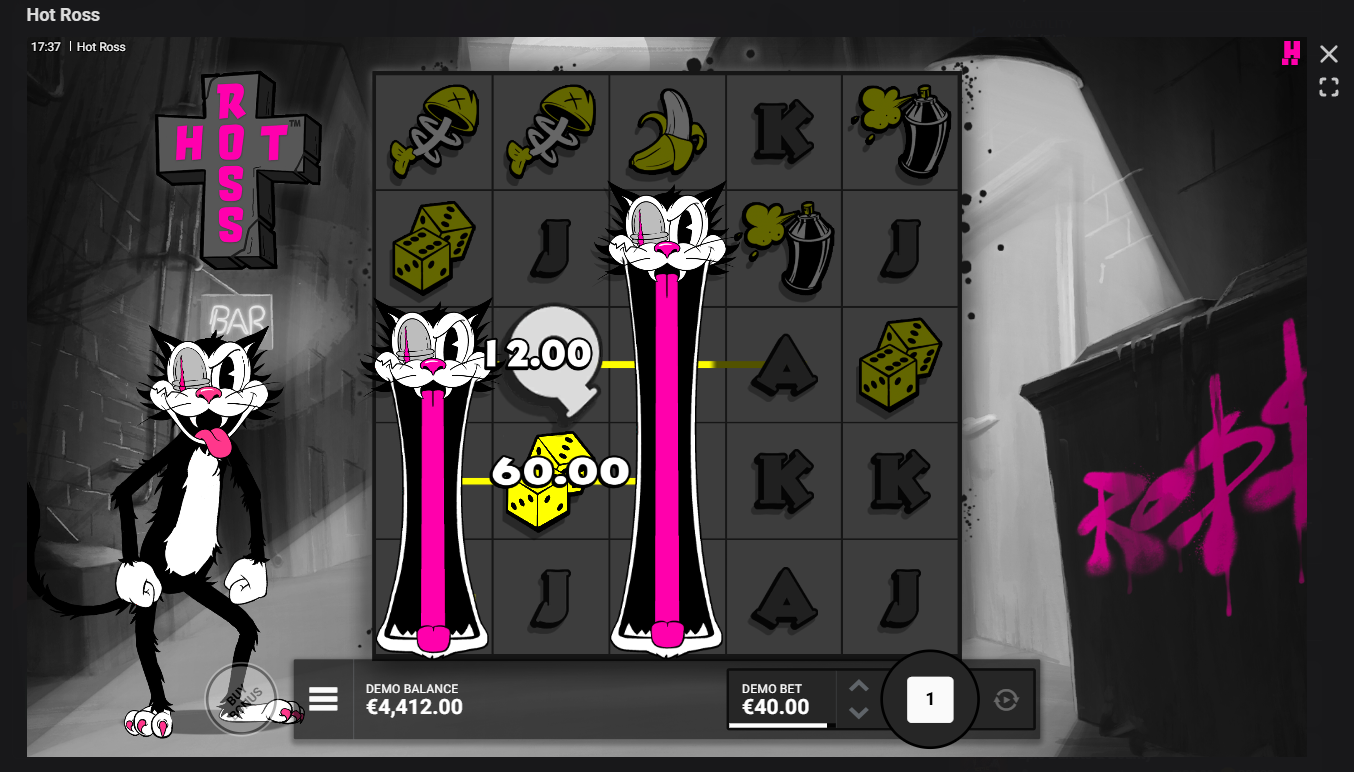
The defining system is the Ro$$ expanding wild. A standard Ro$$ that lands where it would complete or improve a win expands downward, covering every cell below it on its reel. A Hot Ro$$, landing anywhere on a reel, immediately jumps to the top of that reel and expands across all five rows as a full reel-covering wild. That’s when the chain fires: any standard Ro$$ on the directly adjacent reels (left and right) also jumps to the top and expands across all five rows. A single Hot Ro$$ can therefore turn several reels into full wild coverage in one evaluation.
The multiplier layer sits on top. When an expanding Ro$$ or Hot Ro$$ passes through a standard Wild, it collects that Wild’s multiplier. Values are discrete — x2, x10, x15, x20, x25, x50, x100, x200 — and several wilds in one path add up, so a path through an x25 and an x100 Wild produces x125 on that spin’s win. A chain crossing wilds on multiple reels at once can stack the totals well higher.
| Element | How it behaves | What to watch |
|---|---|---|
| Standard Ro$$ (cat head) | Expands downward when part of a win | Landing position and which symbols it covers |
| Hot Ro$$ (pink/yellow) | Jumps to reel top, covers all 5 rows | Triggers the chain — the best base-game event |
| Chain expansion | Neighbouring Ro$$ wilds fired by a Hot Ro$$ | Several reels can convert to wild at once |
| Wild (bomb, W) | Multiplier when an expanded wild crosses it | Position matters — wilds in the path multiply the win |
| Scatter (FS) | 3/4/5 open the bonus tiers | Need 3+ in one spin; they don’t carry over |
| Free-spins retrigger | 2 more scatters = +2 spins; 3 = +4 | Extends the bonus if scatters land again |
Step-by-Step
These steps run a full Hot Ross session from setup to close.
-
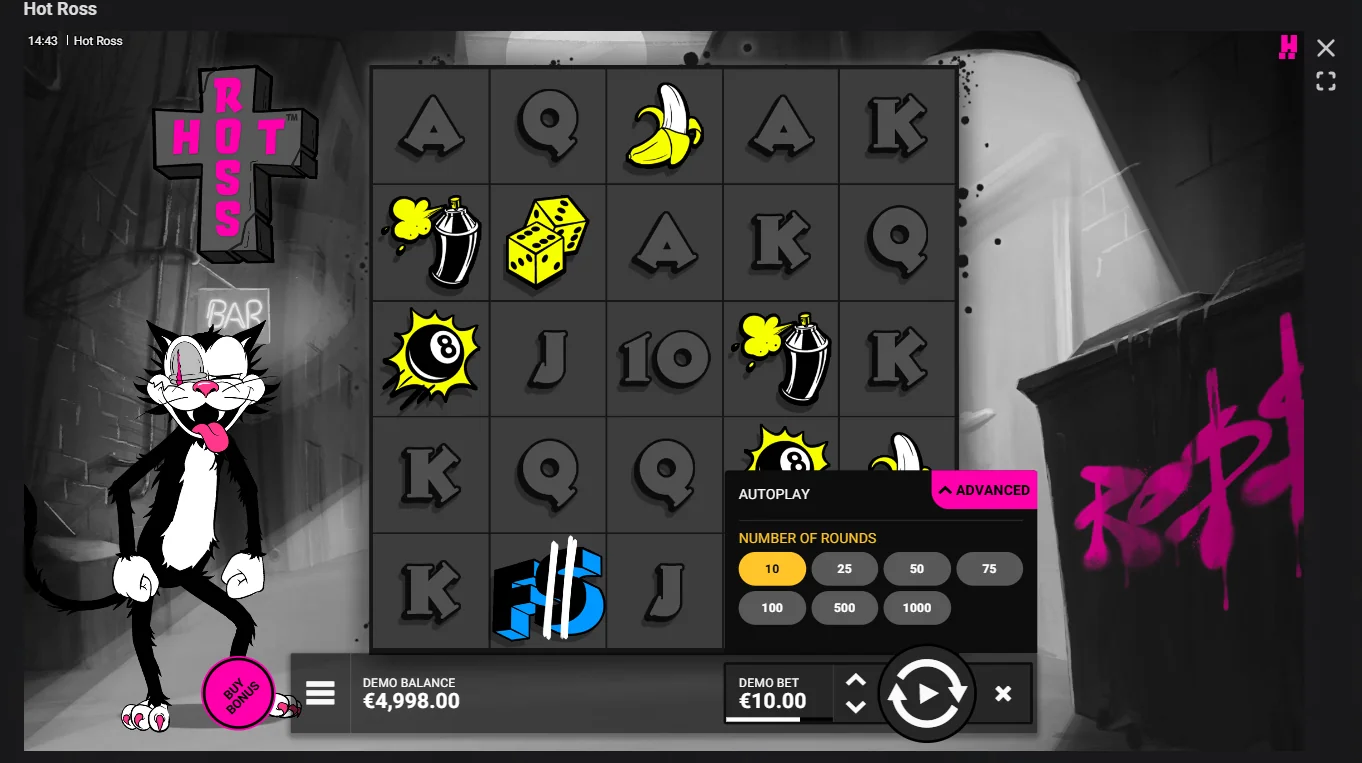
Set the stake before your first spin. Use the coin or stake controls to choose your bet — Hot Ross accepts C$0.10 to C$50 per spin. Your stake scales the size of every win and loss; it does nothing to the odds of any outcome. Pick the stake that equals 1–2% of your session budget, not the biggest one the operator allows.
-
Spend your first 50 spins in demo. Open demo via the operator’s “Play for Free” option or an aggregator review site. Watch how often standard Ro$$ lands, how often Hot Ro$$ shows up, and what a chain looks like when several reels convert together. Notice the length of the no-win stretches — that’s the variance you’re budgeting for on real money.
-
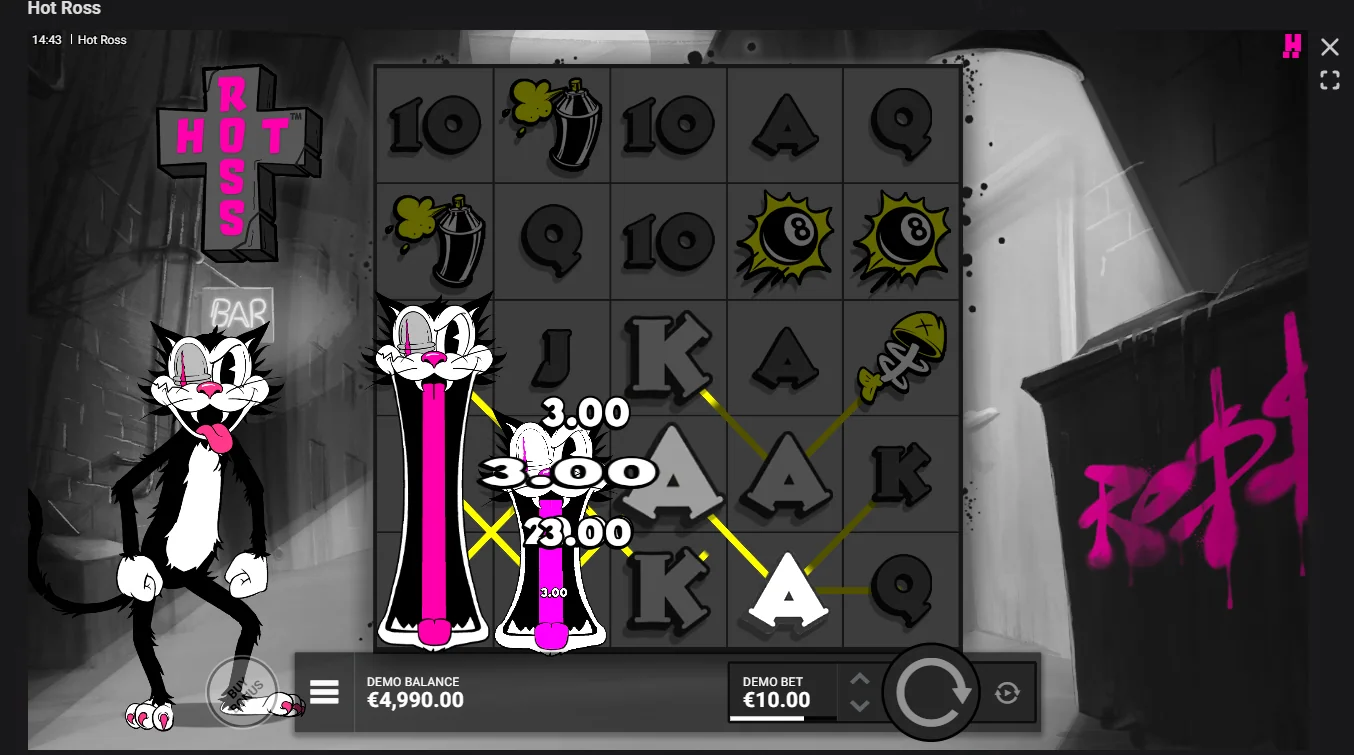
Make your first real-money spin. Press Spin, or start Auto-spin with stop conditions set. Watch for Ro$$ (standard cat head) and Hot Ro$$ (pink/yellow) — your main triggers. Standard Ro$$ expands down; Hot Ro$$ covers the reel and kicks off the adjacent chain.
-
Track Wild positions during an expansion. As a Ro$$ or Hot Ro$$ expands, watch for Wild (bomb) symbols in the columns being covered. Each Wild in the path adds its multiplier. A Hot Ro$$ chain that crosses two or three Wilds is as close as the base game gets to max-win territory.
-
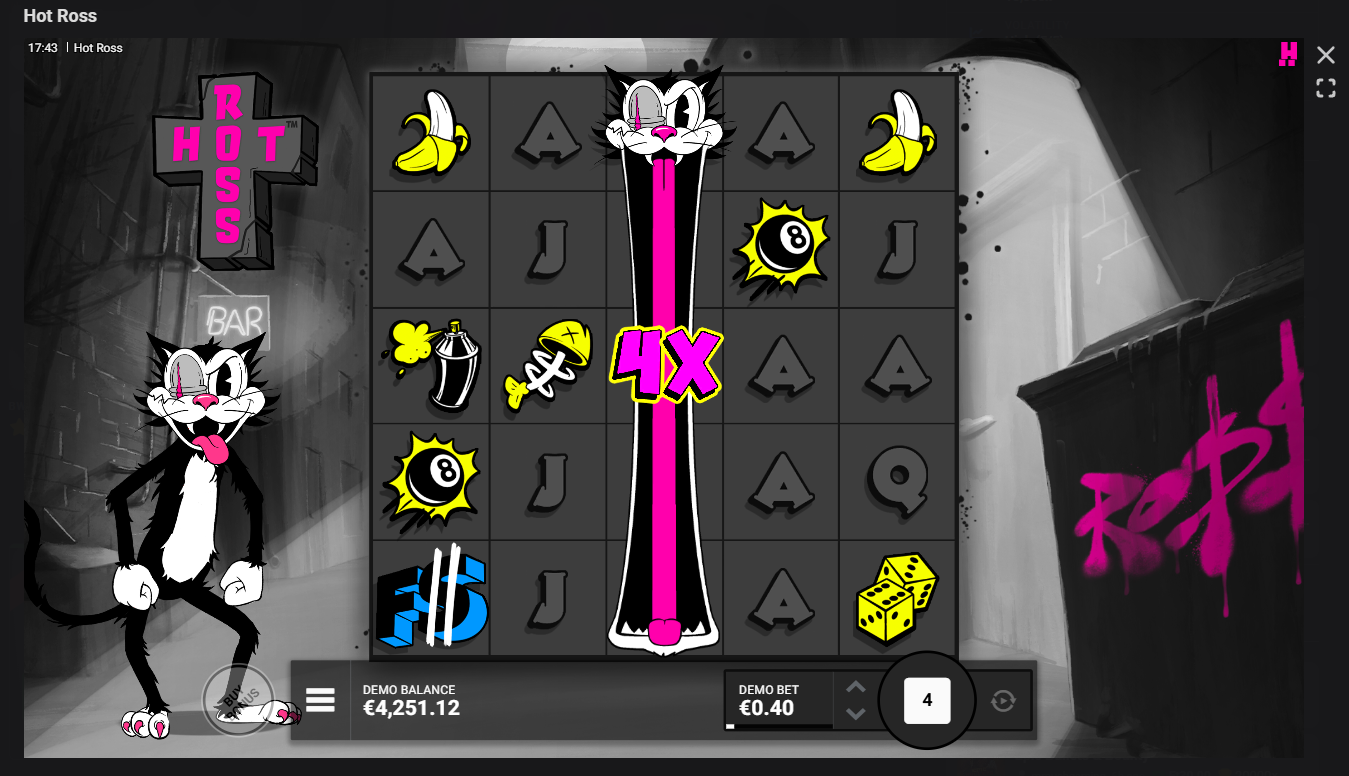
Spot and count the scatters. The FS scatter is a distinct black-and-blue symbol. Three at once open Cat Calls (10 free spins); four open Nine Lives (10 spins, activated-reel mechanic); five open Bigg Boss Ross (10 spins with guaranteed Hot Ro$$ and Wild each spin). Scatters don’t accumulate across spins — all of them must land in the same evaluation.
-
Play the tier you’ve entered. In Cat Calls: ride the 10 spins with elevated Ro$$/Hot Ro$$ frequency and grab retriggers on 2–3 scatters. In Nine Lives: once a Ro$$ or Hot Ro$$ first lands on a reel, that reel is “activated” and guarantees a Ro$$ or Hot Ro$$ on every later bonus spin. In Bigg Boss Ross: every spin carries at least 2 Hot Ro$$ and 1 Wild — the conditions most likely to stack multipliers and reach the higher wins.
-
Close out at your set limit. When your loss hits the figure you fixed beforehand, close the game. No extra deposit to stretch the session. This is the most important step and the one most often skipped during a bad run. A big win on the next spin is always theoretically possible — and always exactly as unlikely as on any other spin. The limit is a hard stop, not a target.
Reading the Screen
| Indicator | What it shows | What to do | Common misread |
|---|---|---|---|
| Balance | Current account balance | Track against your session ceiling | Mistaking total balance for session budget |
| Bet per spin | Your set stake | Verify before each session | Forgetting to reset after a prior session |
| Win display | Win for the evaluated spin | Note whether a Ro$$ or Wild contributed | Reading big wins as a “hot streak” |
| Multiplier indicator | Multiplier collected when a Wild is crossed | Per-spin cumulative value | Treating it as persistent or building |
| History panel | Last 10–20 outcomes | Use only as a game log | Using past scatter gaps to predict future ones |
| FS counter | Remaining free spins | Track retrigger potential | Losing the count |
| RTP info button | The RTP build at this operator | Check it before your first spin | Assuming every operator runs 96.32% |
| Auto-spin settings | Configured stop conditions | Set loss and single-win limits first | Running auto-spin with no stops |
Common Approaches to Hot Ross {#strategies}
Players structure Hot Ross sessions in a few familiar ways. None alters the game’s expected value — that’s locked by the RTP and house edge. What they alter is the session’s shape: how long it lasts, how big the swings feel, and your odds of reaching a bonus before the budget runs dry.
- Flat stake — the same bet every spin. Simple, with consistent per-spin variance. At C$0.50 a spin on a C$50 budget that’s 100 spins to your ceiling — enough to meet the game’s normal variance range.
- Percentage of balance — adjusting each bet to a fixed share of your current balance. Mathematically you can never hit zero, but stakes shrink as the balance drops, which can make a session feel endless at tiny stakes after a bad run.
- Session stop-win — set a win target that ends the session if hit, e.g. doubling the budget. It banks profit from good sessions; it doesn’t improve the next session’s expectation.
- Auto-spin with a loss limit — let auto-spin’s built-in loss cap enforce your ceiling automatically, removing the need for willpower at the end of a losing run.
Why No Strategy Beats RTP {#why-strategies-dont-beat-rtp}
Hot Ross returns about C$96.32 per C$100 wagered on its default build, and that holds no matter how you vary bet size, when you spin, how long you pause, or what the history panel reads. The RNG behind each spin works independently of every prior spin and of any pattern you apply.
The gambler’s fallacy — believing past results shift future odds — feels natural because we’re pattern-finders applied to a process with no pattern. A 40-spin gap since the last bonus does not raise the odds on spin 41; the scatter probability is identical to spin 1. Systems that react to past outcomes — Martingale, reverse Martingale, D’Alembert — all assume history carries information about the future. It doesn’t. In a high-variance game like Hot Ross their only real effect is changing how fast the bankroll drains in bad runs and how large the loss is when a losing streak finally breaks.
What bankroll management genuinely does is set how many spins your budget buys, which sets your odds of reaching a bonus before the money runs out. At C$50 and C$1 a spin, 50 spins; at C$0.50, 100. The per-spin expected loss is the same — the session is just longer, and the chance of catching a trigger in that span rises with it. See our responsible gambling page for where recreational use of these tools ends and chasing losses begins.
After a Session
Win or lose, the same behaviour applies.
After a win: withdraw the profit rather than rolling it back in. Any further session has a negative expectation — the win doesn’t change the edge going forward. If you want to keep playing, set a fresh budget from money you’re fine losing, not from the last session’s profit. Treating winnings as consequence-free “house money” is a classic route from a profitable start to a heavy finish.
After a loss: don’t open another deposit to “get back to even.” Your odds of profit on the next spin are exactly what they were before the losing run. With a 3.68% per-spin edge, a second C$50 session costs the same in expectation as the first. A second or third same-day deposit after losing is a pattern worth noticing. The responsible gambling page has self-assessment tools and Canadian support resources.
Log the result. A simple record — date, budget, outcome — builds an honest long-run picture. Players who don’t track consistently underestimate their total wagering and overestimate their wins, because big wins stick and routine losses fade. Accurate records are the foundation of honest self-assessment.
RNG reminder: every spin is produced by a certified random number generator. Past spins have no bearing on future odds. A long losing run doesn’t predict a win; a long winning run doesn’t predict a loss. The next spin is always a fresh, independent event.
Pre-Session Checklist
Before opening Hot Ross for real money, confirm each item:
- ✓ Session budget set and written down — the most you’ll lose this session, decided up front.
- ✓ Stake at 1–2% of the budget — enough spins to reach the mechanic.
- ✓ Demo tested — at least 30–50 demo spins before going live.
- ✓ Operator RTP build checked — opened the info panel or asked support which Hot Ross version runs.
- ✓ Auto-spin stops configured — loss limit, and optionally a single-win limit, before activating.
- ✓ Session time limit noted — cap the duration, not just the spend; these sessions overrun easily.
- ✓ Not playing to recover a prior loss — if that’s the main motive, stop and read the responsible gambling guidance first.